Witnessed run
We run the published suite against your implementation and sign an attestation of what ran and what it covered. The usual entry condition for governed transactions.
published suiteattested run

Touchstone · Assessment and assurance
Touchstone measures whether an agent holds to its mandate and to whichever protocol governs the exchange, usually A202. It can be bought first, before anything else.
Start with one workflow
We map the workflow, the authority behind each action, and the protocol rules, then test what should succeed and what must fail. You leave with a versioned result and a defined production scope.
Missing, expired, revoked, and out-of-scope mandates, including financial and counterparty limits.
Whether each participant receives only the fields and events allowed for its role.
Stale versions, reordered events, and conflicting changes, to confirm which offer, approval, or award is current.
Mismatched terms, missing approval, and unilateral signature, to confirm an obligation forms only on one object signed by both sides.
Whether the signed sequence reconstructs without screenshots, private application state, or recollection.
Each area is tested by attempting the action that should be refused.

Expired authority, unauthorized disclosure, stale state, or a missing approval should produce a visible refusal at the moment it happens.
The engagements
Anyone can run the public A202 suite for free, and a published test can be coded against. A grade uses cases the implementation has never seen, built from the protocol and the mandate that apply.
We run the published suite against your implementation and sign an attestation of what ran and what it covered. The usual entry condition for governed transactions.
The implementation is measured against cases it has never seen and receives a signed grade per dimension. Grades expire at twelve months or the next specification version.
A human assessor builds inputs outside any published or held-out set and judges each refusal: correct reason, nothing leaked, no permissive default.
Your own deployment, exercised against expired authority, leak-shaped events, unreachable status endpoints, and malformed input. Refusal is found in rehearsal.
Courses for the people who operate governed transactions: control owners, auditors, procurement leads, engineers. The credential expires and must be renewed.
What a grade is not
Fees are fixed by scope and never depend on the result. A grade is our own assessed statement for one specification version. It is not certification by a standards body, regulator, auditor, or insurer.
Who reads the result
Commercial
Which agent could issue the offer, which terms are current, and which approval is still required?
Legal and finance
What did each organization sign, which mandate supported it, and when did the obligation become binding?
Security and risk
What was disclosed, whether it was permitted, and whether revoked authority was refused immediately?
Audit and counterparties
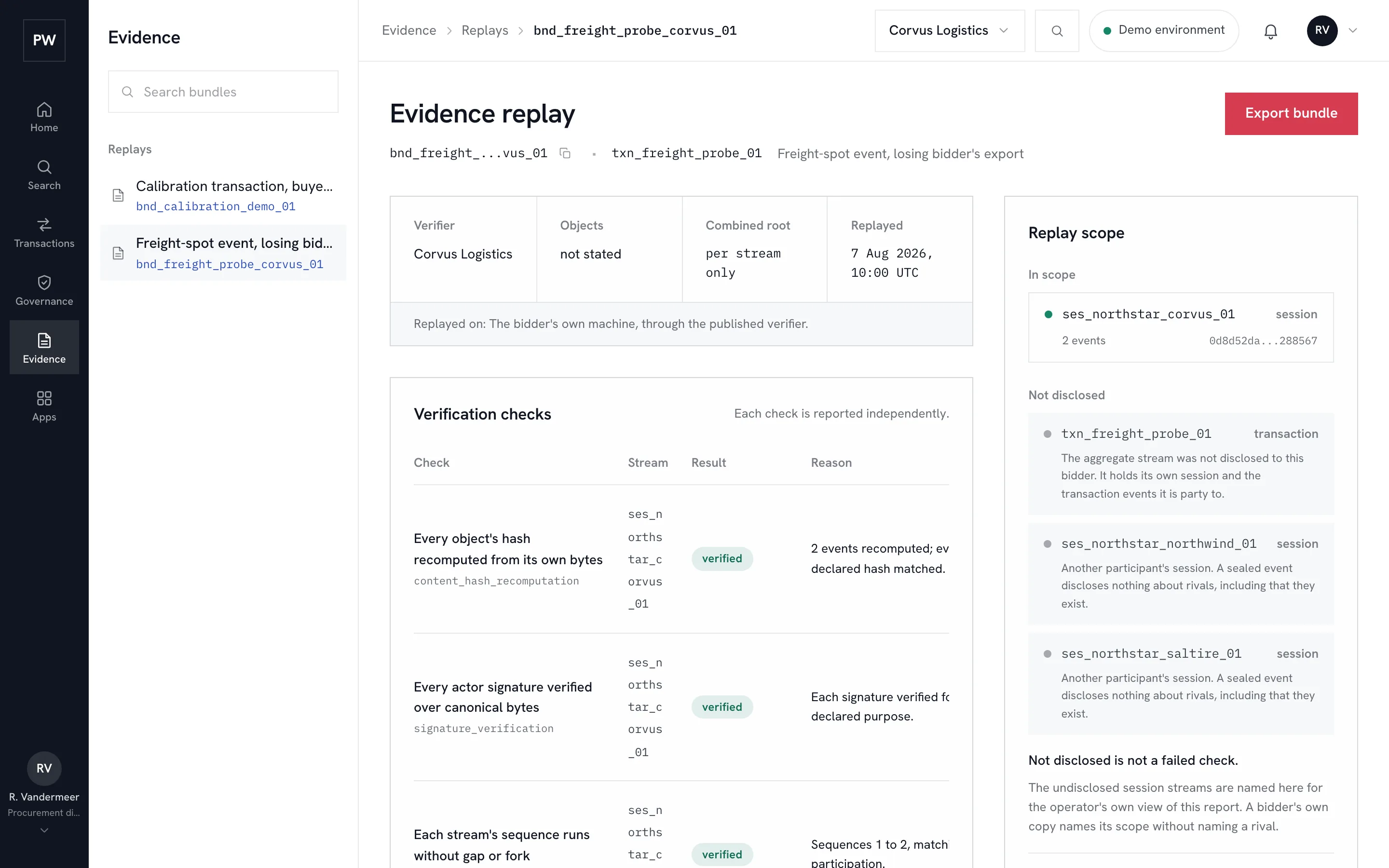
Can the signed sequence be replayed without access to either organization's private systems?